
Almost Seen: Exploring Visibility, Desire and Reclaimed Materials in Contemporary Art

What do we stop seeing when we get used to looking away?
A discarded piece of fabric becomes waste. A desire becomes something to keep private. A vulnerable body becomes something to judge. After a while, these things can disappear from our attention so completely that their absence begins to feel normal.
But what if being out of sight is not the same as being absent?
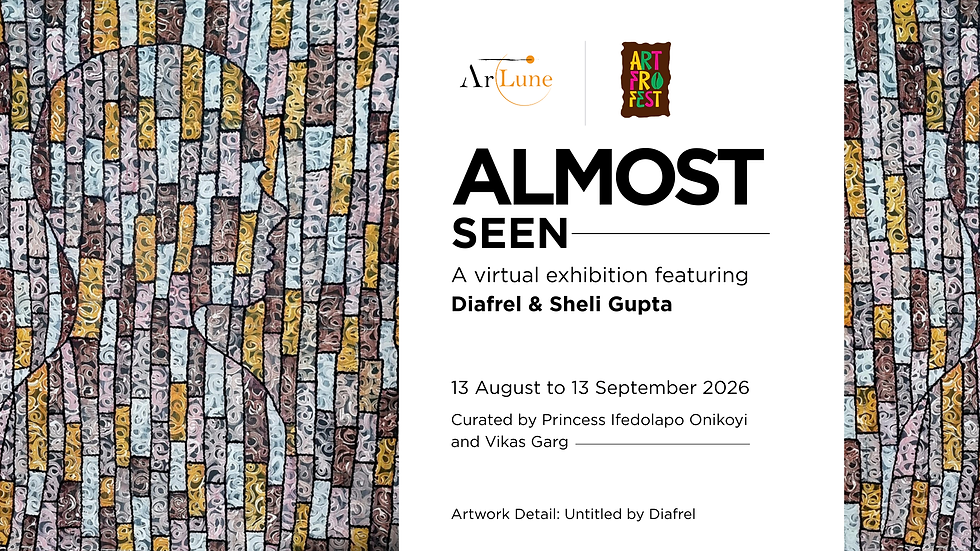
This is the question at the heart of Almost Seen, a virtual contemporary art exhibition presented by Artlune in collaboration with ArtFroFest.
Bringing together Indian contemporary artist Sheli Gupta and Ivorian-born, France-based artist Diafrel, the exhibition explores visibility, concealment, desire, vulnerability, memory and the traces left behind by things we choose or are asked to overlook.
Rather than asking two artists to tell the same story, Almost Seen brings two very different practices into conversation.
Two Artists, Two Ways of Looking
Sheli Gupta's artistic practice has developed through an ongoing engagement with female subjectivity, desire and vulnerability.
Her early work explored women's hidden sexual desires and the emotional experiences that often remain unspoken. Over time, her practice has moved beyond direct representations of the female body towards questions of identity, memory, emotion and the relationship between what is visible and what remains beneath the surface.
Her use of mixed media on paper and acrylics on paper plays an important role in this process. Paper, thread and cloth are layered, built up and reworked to create surfaces that can conceal as much as they reveal.
For Sheli, the female body is not simply something to be looked at. It becomes a way of thinking about agency, vulnerability and the expectations placed on women.
This makes her work particularly relevant to Almost Seen. The question is not simply whether something is visible, but who gets to decide what can be seen and on whose terms.
Diafrel approaches the question from a very different direction.
An artist of Ivorian origin based in the Île-de-France region, Diafrel is known for working with reclaimed materials. Worn textiles, cardboard, tarpaulin and other discarded surfaces become the starting point for his paintings.
His mixed-media practice uses impasto and paint scraping on reclaimed fabrics, allowing the original texture and history of the material to remain part of the finished work.
The material has already lived a life before it reaches the artist's studio.
It may have been used, damaged, discarded or simply considered no longer useful. Diafrel does not completely erase that history. Instead, he works with it.
That approach connects his artistic practice to broader questions around consumption, waste, ecology and the value we assign to everyday materials.
What Connects Their Practices?
At first, Sheli Gupta and Diafrel may seem like an unlikely pairing.
One works extensively with the body, desire and emotional experience. The other begins with reclaimed materials and questions around ecological and social life.
But this difference is exactly what makes the exhibition work. Both artists are interested in things that have been pushed away from immediate view.
In Sheli's work, this can be desire, vulnerability or aspects of identity that society encourages us to suppress.
In Diafrel's work, it can be a material that has been classified as waste and removed from our surroundings.
The connection is not that their works look alike. They don't. The connection lies in the way both artists ask us to look again.
This is also where the title Almost Seen becomes significant. Something can be partially hidden and still remain present. A layer can cover something without completely removing it. A discarded surface can carry marks from its previous life. A feeling that has been suppressed can still shape the person experiencing it.
The exhibition asks us to pay attention to those traces.
Why Material Matters
One of the most interesting aspects of Almost Seen is the role of material.
In contemporary art, materials are often discussed in terms of technique: what an artist uses, how they use it and what process they follow. Here, the material carries part of the meaning.
Diafrel's reclaimed fabrics are not neutral surfaces. Their wear, folds and existing marks become part of the artwork.
Sheli's layers work differently but create a similar tension. Thread can hold, connect, restrict or protect. Paper can cover and reveal. Cloth can conceal the body while also drawing attention to it.
In both practices, layering becomes a way of thinking.
Something can be hidden by adding another layer. But that same process can also reveal something gradually. The difference lies in intention.
A Collaboration Across Artistic Contexts
Almost Seen is also the result of a collaboration between Artlune and ArtFroFest.
Artlune works closely with South Asian artists and creates platforms for their practices to reach wider audiences. ArtFroFest works across contemporary African art, cultural exchange and artistic dialogue.
Bringing the two organisations together creates an opportunity to connect artistic practices from different regions without forcing them into a single narrative.
The exhibition does not attempt to define what Indian art or African art should look like. Instead, it allows two individual artists to bring their own experiences, materials and questions into the same space.
That makes the collaboration valuable beyond geography. It becomes a conversation about how artists respond to the things their societies choose to see, ignore, value or discard.
Looking Again
Perhaps the most interesting thing about Almost Seen is that it does not ask the audience to solve a problem.
It asks us to notice one.
What have we become comfortable overlooking?
What do we call waste?
What do we call unacceptable?
What do we hide because we have been taught that it should remain hidden?
And what might become visible if we simply gave it more time?
Through the contrasting practices of Sheli Gupta and Diafrel, Almost Seen explores these questions without offering one fixed answer.
The exhibition is currently live on the website. Visit the exhibition and share your feedback with us.
