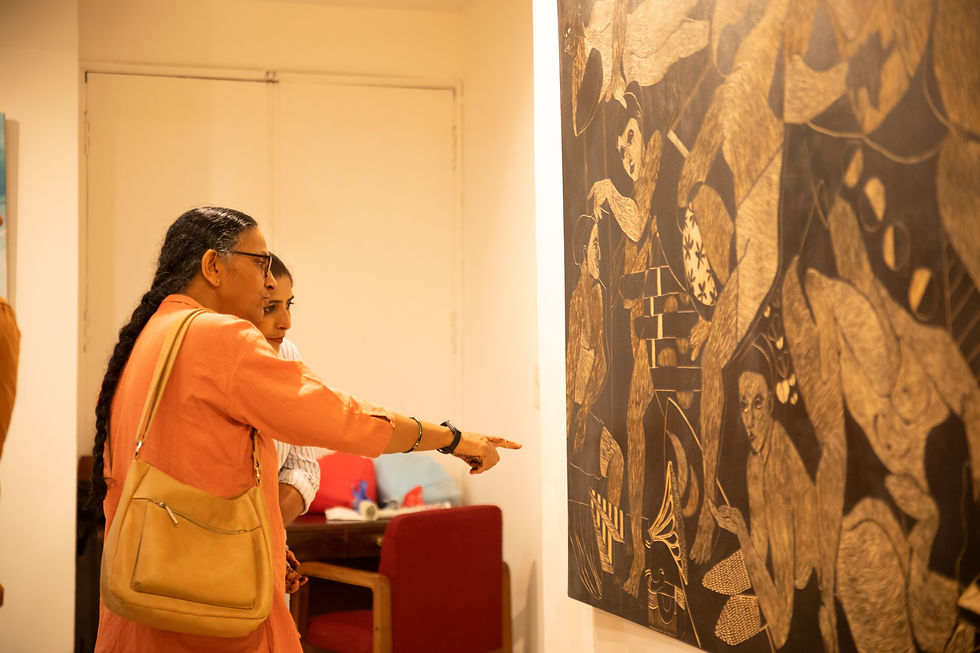
South Asian Art Gallery: Where to Discover Contemporary Art from South Asia

When people search for a South Asian art gallery, they are often looking for more than a place to view paintings. They are looking for a way into a region with an incredibly complex artistic history, one that stretches across India, Pakistan, Bangladesh, Sri Lanka, Nepal, Bhutan, Afghanistan, the Maldives, and their global diasporas.
But there is a problem with the way South Asian art is often presented.
It is frequently reduced to a familiar set of references: miniature paintings, religious sculpture, textiles, mythology, or traditional craft. These histories matter deeply, but South Asian art is not a museum object frozen in the past. It is a living and constantly changing field.
The most interesting question today is not simply what is South Asian art?
It is: what are South Asian artists making, questioning, and imagining now?
That is where contemporary South Asian art becomes particularly important.

What Does a South Asian Art Gallery Really Represent?
A South Asian art gallery is not simply a space that presents artists from a particular geographical region. At its best, it creates a context for understanding the ideas, histories, and experiences that shape their work.
Contemporary South Asian artists are working across painting, sculpture, photography, textiles, video, installation, mixed media, and digital practices. Their work may engage with heritage, but it can also address migration, climate change, gender, politics, urbanisation, memory, labour, technology, and belonging.
This is why the term "South Asian art" should not be treated as a visual style.
There is no single South Asian aesthetic. A contemporary artist from Sri Lanka may be responding to a very different history from an artist based in Nepal. An artist from Pakistan may explore displacement and political memory differently from an artist working in Bangladesh or India. Artists from the diaspora may engage with South Asia through inherited memories, family histories, and questions of cultural identity.
The category is broad, but that is precisely its strength.
South Asian Contemporary Art Is Moving Beyond Borders
For a long time, the global art world often treated South Asia through national categories. Indian art, Pakistani art, Bangladeshi art, and Sri Lankan art were frequently discussed separately.
Today, there is a growing recognition that many of the region's artistic conversations cross national borders.
A recent exhibition at SOAS (Un)Layering the Future Past of South Asia: Young Artists' Voices brought together 26 young artists from India, Pakistan, Bangladesh, Sri Lanka, Nepal, and Afghanistan. The exhibition was built around shared histories and contemporary concerns, including migration, ecological stress, gender inequality, and the legacies of empire. (SOAS)
This kind of curatorial approach is important because it allows audiences to see South Asia as a connected but deeply diverse cultural space.
The region has experienced centuries of movement, exchange, trade, migration, colonialism, partition, and cultural interaction. Contemporary art naturally reflects these entangled histories.
The Contemporary South Asian Art Scene Is Growing, But Not Without Challenges
There is no doubt that international interest in South Asian art is increasing.
The Indian art market, in particular, has experienced significant growth, driven by domestic collectors, new wealth, increased cultural infrastructure, and greater international attention. Art Basel reported that many buyers entering the Indian market today are new collectors, while galleries and institutions are seeing stronger interest in contemporary and modern Indian art. (Art Basel)
This growth is encouraging. More collectors mean more opportunities for artists, galleries, institutions, and cultural organisations.
But growth also raises important questions.
Who benefits from this expansion? Are emerging artists receiving long-term support, or are they being pushed into the market too quickly? Is the focus still concentrated around a small number of established names? Are artists from across South Asia receiving equal visibility?
These are questions the art world cannot avoid.
The Art Basel and UBS Art Market Report 2025 found that sales among contemporary art dealers declined in 2024, while sales became increasingly concentrated around a small number of top artists. Fifty-six per cent of dealer sales came from their top three artists. (The Art Market)
This concentration matters because a healthy art ecosystem cannot depend only on already-established names.
The future of South Asian art depends on building stronger pathways for emerging and mid-career artists before the market discovers them.
Why Emerging Artists Need More Than Visibility
One of the biggest misconceptions about supporting artists is that visibility alone is enough.
Being featured online, included in an exhibition, or gaining social media followers can help. But a sustainable artistic career requires much more.
Artists need access to thoughtful curatorial opportunities, professional guidance, collectors, conversations, networks, and the knowledge required to navigate the art world.
This is particularly important for artists working outside major cultural centres or without established institutional networks.
A gallery or platform that focuses on emerging artists therefore has a responsibility beyond displaying artwork. It must also help create the conditions in which artists can develop.
This is where we believe the role of a contemporary South Asian art platform needs to be reconsidered.
Artlune: Building More Than an Online Gallery
At Artlune, we began with a simple observation: many talented South Asian artists were creating meaningful work but did not have access to the visibility, guidance, and networks needed to build sustainable careers.
The art world could feel difficult to enter. Artists often knew how to make the work but were less certain about how to position their practice, approach galleries, communicate with collectors, build professional portfolios, or find the right opportunities.
Artlune was created to address that gap.
As an online gallery and community-driven platform focused on contemporary South Asian art, we work with emerging and mid-career artists from the region and its diaspora. Our role extends across curated exhibitions, artist development, advisory, collector engagement, and cultural programming. (Artlune)
For us, the online format is not simply a matter of convenience.
It creates the possibility of connecting artists and audiences across geographical boundaries. A collector in the UK can discover an artist working in India. A viewer in another country can encounter an exhibition rooted in a South Asian experience that may be unfamiliar to them. An artist can access conversations and opportunities that may not exist within their immediate local ecosystem.
Digital access cannot replace physical exhibitions or the importance of galleries and institutions. But it can expand the ways in which people encounter art.
The Future of the South Asian Art Gallery
The idea of a gallery is changing.
A gallery can be a physical space, an online platform, a community, an exhibition, a conversation, or a network of relationships. Increasingly, it can be all of these things at once.
For South Asian contemporary art, this broader understanding is particularly valuable. The artists and audiences connected to the region are already spread across countries and continents. A contemporary art ecosystem must reflect that reality.
The future will not be built only through larger exhibitions and higher auction prices. It will also depend on the quieter work of supporting artists early in their careers, developing informed collectors, creating meaningful cultural exchange, and making art accessible beyond traditional centres of power.
That is the space Artlune is trying to contribute to.
We do not believe South Asian art needs to be made more acceptable to the global art world. It already contains extraordinary complexity, innovation, and relevance.
What it needs are more platforms willing to give that complexity the attention it deserves.
And perhaps that is what a South Asian art gallery should ultimately be: not a place that tells audiences what South Asian art is, but a space that allows artists from the region to show us what it can become.
References