Why South Asian Art Is More Significant Than Ever

For a long time, South Asian art was introduced to the world through a narrow lens. It was often presented as temple sculpture, miniature paintings, religious icons, or craft traditions. While these histories are undeniably important, they tell only part of the story.
Today, South Asian art occupies a very different place in the global cultural landscape. It is no longer viewed solely as an ancient tradition or a regional practice. It has become a powerful way of understanding identity, migration, memory, politics, spirituality, and cultural exchange. Museums are expanding their collections, international galleries are representing more South Asian artists, and collectors are paying closer attention than ever before. Yet its significance extends far beyond growing market interest.
South Asian art matters because it helps us understand people. It reveals how cultures evolve, how histories are remembered, and how creativity continues to bridge the past and the present.

South Asian Art Cannot Be Reduced to a Single Tradition
One of the biggest misconceptions about South Asian art is that it represents one unified style.
In reality, South Asia is one of the most culturally diverse regions in the world, encompassing India, Pakistan, Bangladesh, Sri Lanka, Nepal, Bhutan, and the Maldives. Within these countries exist hundreds of languages, communities, religions, and artistic traditions that have developed over thousands of years. (The Metropolitan Museum of Art)
This diversity is precisely what gives South Asian art its richness. A Buddhist sculpture from ancient Gandhara, a Mughal miniature from Lahore, a Madhubani painting from Bihar, and a contemporary installation from Colombo may look entirely different, yet each reflects the social, cultural, and historical context from which it emerged.
Rather than searching for one visual identity, it is more useful to think of South Asian art as a conversation between many histories.
It Preserves Histories That Cannot Always Be Written
History is often told through documents, rulers, and political events. Art tells a different story.
Across South Asia, artworks have preserved everyday life, rituals, beliefs, migration, craftsmanship, and community memory in ways written records often cannot. Temple carvings reveal clothing, music, and social customs. Miniature paintings capture courtly life alongside literature and poetry. Folk traditions record local myths, seasonal festivals, and oral histories that may never have appeared in official archives. (The Metropolitan Museum of Art)
This becomes especially important in regions shaped by colonialism, Partition, displacement, and political conflict. In many cases, art has become a form of cultural memory, carrying stories that might otherwise disappear.
For contemporary artists, this relationship with history continues. Many draw upon family archives, inherited traditions, photographs, textiles, or personal memories to explore how history continues to shape the present.
South Asian Art Has Always Been About Exchange
It is tempting to think of artistic traditions as isolated or fixed, but South Asian art has always evolved through exchange.
For centuries, the region sat at the centre of major trade routes connecting East Asia, Central Asia, the Middle East, Africa, and Europe. Ideas, materials, religions, and artistic techniques travelled alongside merchants and pilgrims.
The Gandhara school combined South Asian and Hellenistic influences to create some of the earliest images of the Buddha. Mughal painting emerged through conversations between Persian, Central Asian, and Indian traditions. Islamic architecture introduced new approaches to geometry, calligraphy, and ornament while absorbing local craftsmanship. (The Metropolitan Museum of Art)
This ability to absorb influences without losing cultural identity remains one of South Asia's defining strengths. Rather than preserving traditions unchanged, artists have continually adapted them to new realities.
Contemporary South Asian Art Challenges Old Narratives
For many years, international audiences expected South Asian artists to produce work that looked recognisably "Indian" or "South Asian." Traditional motifs, bright colours, or religious imagery were often treated as markers of authenticity.
Contemporary artists are challenging those assumptions.
Today's practitioners work across photography, installation, performance, video, sculpture, textiles, and digital media. Their work explores climate change, migration, gender, labour, technology, memory, urbanisation, and political violence alongside questions of belonging and identity.
Some artists continue traditional practices such as miniature painting or weaving, but they use these languages to speak about present-day issues rather than historical nostalgia. Others move entirely beyond conventional forms while remaining deeply connected to South Asian experiences.
Their work reminds us that culture is not static. It continues to evolve with every generation.
It Offers Different Ways of Seeing the World
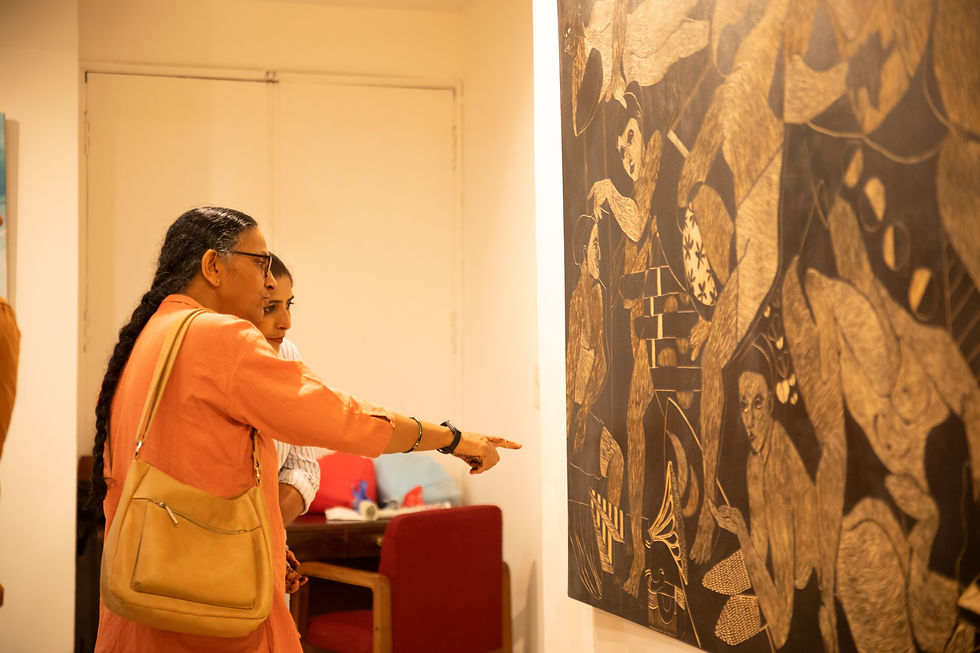
One of the most valuable aspects of South Asian art is that it often encourages slower looking.
Many works are less concerned with immediate visual impact than with sustained attention. Layers reveal themselves gradually. Symbols carry multiple meanings. Silence and negative space become as significant as colour and form.
This reflects broader philosophical traditions across the region, where ideas of interconnectedness, impermanence, spirituality, and reflection have shaped artistic practice for centuries. (The Metropolitan Museum of Art)
Even contemporary artists working in abstract or conceptual forms frequently engage with these ways of thinking, creating work that invites contemplation rather than quick consumption.
In an increasingly fast-moving visual culture, that quality feels particularly significant.
Recognition Is Growing, But Representation Still Matters
The global visibility of South Asian art has increased dramatically over the past decade.
Museums are expanding collections, major exhibitions are highlighting South Asian modernism, and artists from the region are receiving increasing international recognition. Auction records have also reflected growing interest among collectors, particularly for both modern and contemporary South Asian artists. (The Guardian)
This momentum is encouraging, but visibility alone is not enough.
For decades, the global history of art was largely written through European and North American perspectives. Many South Asian artists remained underrepresented despite their significant contributions.
Greater recognition should not simply mean adding more South Asian names to museum walls. It should also encourage broader conversations about how global art histories are written, whose voices are included, and whose stories remain overlooked.
Why This Matters for Emerging Artists
For emerging South Asian artists, understanding this history is not about copying tradition. It is about recognising that they are part of a much longer conversation.
Every generation inherits visual languages, cultural memories, and ways of making. Some artists choose to preserve them. Others challenge them. Many do both simultaneously.
The strongest contemporary practices often emerge from artists who understand where they come from while remaining open to new ideas.
South Asian art has never stood still. Its history is one of constant movement, adaptation, and reinvention.
Why We Need South Asian Art Today
At Artlune, we believe the significance of South Asian art lies not only in its history but also in its ability to shape the future.
It reminds us that culture is built through many voices rather than a single narrative. It preserves knowledge that cannot always be captured through words. It creates space for difficult conversations around identity, migration, memory, and belonging. Most importantly, it helps us see one another with greater empathy.
In a world that often rewards speed and simplification, South Asian art asks us to slow down. It encourages us to look beyond the surface, to embrace complexity, and to recognise that every artwork carries the weight of lived experience.
That is what makes South Asian art significant. It is not simply a record of where the region has been. It is an ongoing conversation about who we are, how we remember, and how we imagine the future together.