Almost Seen: What Happens When We Look Again?

What do we stop seeing once we decide something no longer matters?
A discarded cardboard box becomes waste. A piece of thread becomes something ordinary. A feeling that does not fit social expectations gets pushed aside. A memory becomes something we rarely revisit. Yet, being out of sight does not necessarily mean that something has disappeared.
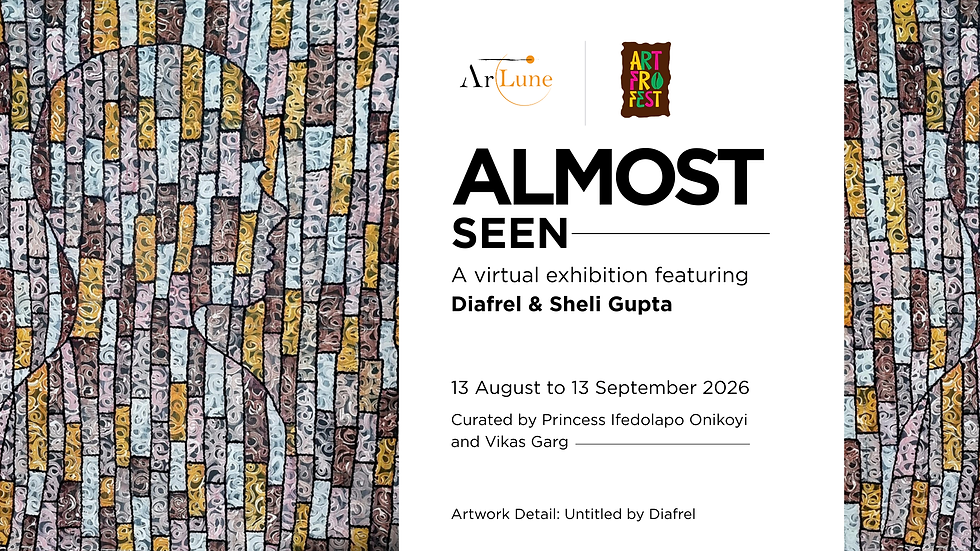
This question sits at the heart of Almost Seen, the exhibition curated by Artlune in collaboration with ARTFROFEST, bringing together the practices of Delhi-based artist Sheli Gupta and France-based artist Diafrel. The opening conversation explored what happens when we slow down and look again at things that have been overlooked, concealed, restricted, or pushed out of view.
Rather than presenting two artists whose work looks similar, the exhibition deliberately brings together two very different practices. Diafrel works with discarded materials and ecological concerns, while Gupta explores female desire, intimacy, vulnerability, and the social restrictions placed around the body. Their practices meet through a shared interest in what exists beneath the surface.

Why “Almost Seen”?
The title began with a simple distinction: something absent is no longer there, while something concealed is still present. It has simply been pushed out of view.
That difference became the starting point for the exhibition.
Diafrel's materials have already had a life before they enter his work. Cardboard, textiles, trampoline surfaces and other discarded materials are usually seen as objects whose purpose has ended. His practice asks us to reconsider that assumption. Instead of erasing the previous life of these materials, he works with their folds, marks, textures and imperfections, allowing those traces to remain visible within the new work.
Gupta approaches concealment through a very different subject: the human body and the emotions carried within it.
Her work considers desire, intimacy, vulnerability and the expectations that influence what women are allowed to express. Through thread, fabric, paper and mixed-media processes, she creates figures that are visible but never completely revealed.
The two artists are not saying the same thing. And that difference is important.
The exhibition does not try to force a similarity between them. Instead, it asks what becomes possible when two different practices are placed in conversation with one another.
Two Artists, Two Ways of Looking Beneath the Surface
For ARTFROFEST, the collaboration grew from a shared interest in creating meaningful dialogue between contemporary art practices from Africa and South Asia. Rather than beginning with a large exhibition representing two regions, the collaboration chose a more focused approach: two artists, a small selection of works, and a specific curatorial question.
This approach allowed the differences between Gupta and Diafrel to remain visible while also revealing unexpected connections.
Diafrel asks us to reconsider what we discard. Gupta asks us to reconsider what we silence or restrict.
Both ultimately draw attention to something that exists beyond what we immediately see.
That is where the exhibition becomes particularly interesting. It does not ask viewers to find one fixed meaning in the works. Instead, it encourages a slower kind of looking.
What are we overlooking?
What have we decided is no longer important?
And what might we understand differently if we gave it another moment?
Sheli Gupta: When the Body Carries What Cannot Be Said
During the opening, Gupta spoke about how her practice developed through her interest in desire and the ways thoughts, emotions and experiences can exist simultaneously.
Her interest in the female body developed from thinking about it not simply as an image or subject, but as a space that carries intimacy, vulnerability, personal experience and desire. This also led her to question why some desires are accepted while others are expected to remain hidden or controlled.
Thread became particularly important in this exploration. It can connect, bind, construct and restrict. It can create boundaries, but it can also cross them.
In Gupta's works, the thread becomes more than a material. It becomes a way of thinking about the boundaries people create around bodies and themselves. Her layered figures are present, but they are not completely revealed. The viewer is encouraged to wonder what the figure might be feeling, what it chooses to reveal and what it chooses to keep private.
This also explains why her work cannot be reduced to questions of the female nude.
Gupta herself spoke about working with emotions and thoughts that society often expects people to hide. The figures become a way of exploring these suppressed experiences rather than simply representing the body.
Diafrel: Giving Discarded Materials Another Life
Diafrel's practice begins somewhere else entirely.
His materials have already been judged.
A cardboard box has delivered its contents and is ready for the bin. A discarded textile is considered finished. A used surface is no longer expected to have value.
Diafrel interrupts that process. He takes these materials and works back into them, allowing their earlier histories to remain part of the artwork. Rather than hiding their imperfections, he incorporates them into new visual narratives through painting and layering.
There is something quietly powerful about this process. The material does not become valuable because its previous life has been erased. It becomes interesting because that previous life remains visible.
The discarded surface becomes evidence of something that happened before. And suddenly, something we had stopped looking at asks us to look again.
When Material Becomes Part of the Story
One of the most engaging conversations during the opening centred on a question that is easy to overlook: can the material itself influence the story an artwork tells?
The answer emerging from the discussion was yes.
The material an artist chooses can carry associations, memories and social meanings before the artwork even begins. In Gupta's case, thread and fabric connect to ideas of domesticity, clothing, restriction and the boundaries historically associated with women's lives. Yet the same thread that can create a boundary can also connect two pieces together and become a source of strength.
Diafrel's discarded materials carry a different history. Their value has already been determined by society: they are no longer needed.
By bringing them back into focus, the artist challenges that judgement.
The material therefore does not merely support the artwork's story. It becomes part of the story.
What Do We Choose to Discard?
Perhaps the most unexpected part of the opening conversation came when the discussion moved beyond the artworks.
Vikas Garg asked participants how they decide when to discard a material or an emotion.
The conversation quickly revealed that the two may not be as different as they first appear.
A broken object can be thrown away because it is considered damaged or no longer useful. But what happens with emotions? Do we discard them, or do we learn to live with them and transform them?
The discussion turned towards the social expectations that teach people which emotions are acceptable and which should be hidden. Participants spoke about heartbreak, vulnerability and the importance of first accepting what we feel before trying to move forward.
This brought the exhibition's central idea into everyday life. Sometimes what we call “discarding” is actually transformation. Sometimes something has not disappeared at all.
We have simply stopped looking at it.
Almost Seen Is an Invitation to Look Again
The opening of Almost Seen was not about providing viewers with one final interpretation of the exhibition.
It was about beginning a conversation.
The exhibition brings together two artists from different cultural and artistic contexts without pretending that their practices are the same. Instead, it creates space for their differences to reveal unexpected connections.
Diafrel asks us to reconsider discarded materials. Gupta asks us to reconsider concealed emotions and restricted forms of expression.
Together, their works encourage us to think about everything that exists just beyond immediate attention: memories, materials, emotions, identities and experiences.
Perhaps that is what “almost seen” really means. Not invisible. Not absent. Only waiting for us to look a little longer.
And sometimes, when we do, what we thought we knew begins to look completely different.