Portia Roy and the Physical Language of Woodcut Engraving Art

Have you ever watched someone work and thought, that person means every single thing they are doing?
That is the feeling you get when you look at Portia Roy's practice. There is a reason for that, and once you understand it, the way you look at her work changes completely.
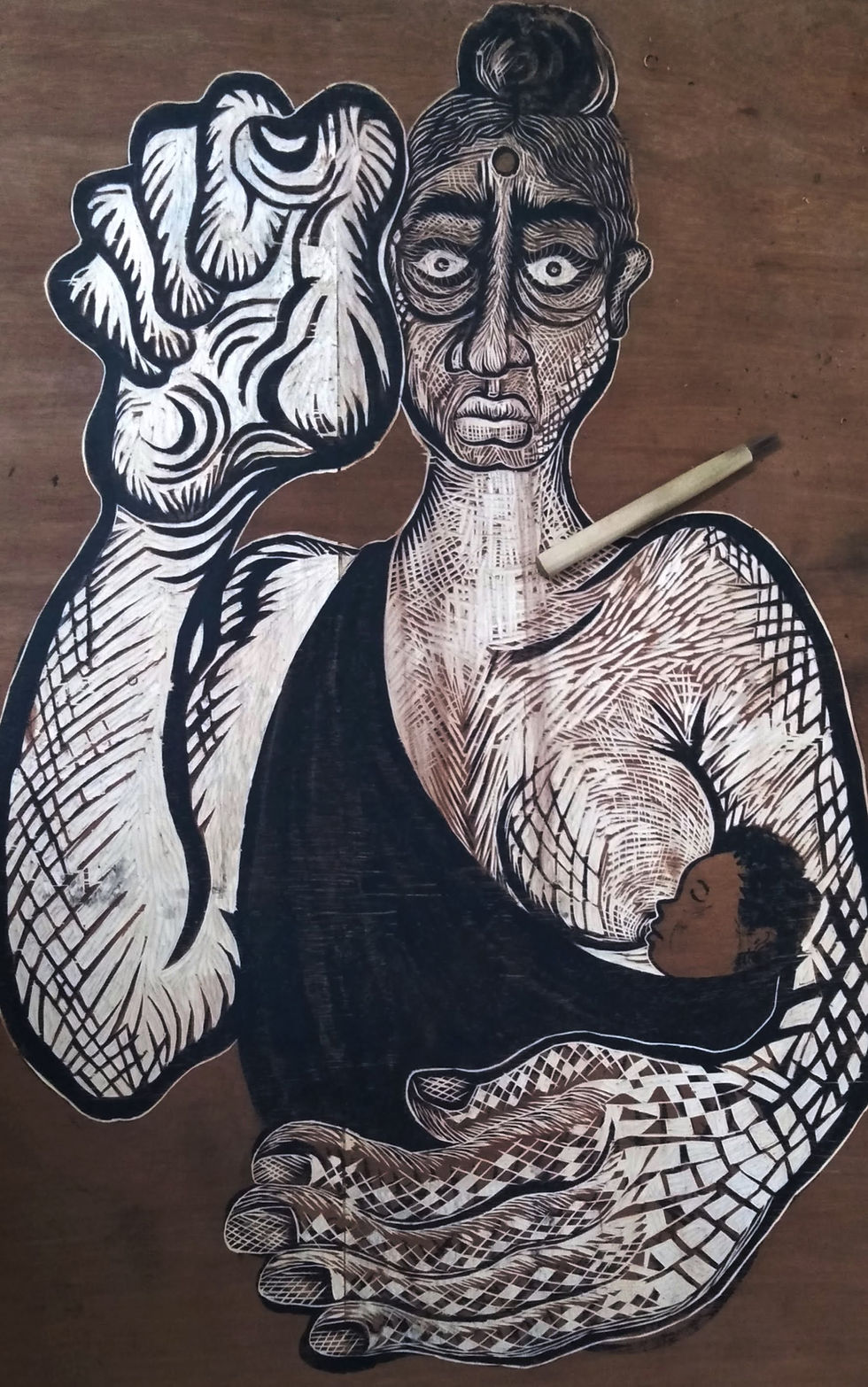
She does not paint. She scratches and carves into hard surfaces like plywood. It is something she deliberately works with, because for Roy, the physical struggle of making is inseparable from the weight of what she is making about.

The Tradition Behind Woodcut Engraving Art
Woodcut engraving is an old medium with a long memory. Historically, it has been used for protest and social commentary, to make political posters, document the suffering of workers, and bear witness to the realities of war.
Roy places herself firmly within this tradition. Not as a stylistic exercise, but as a commitment to the stories she feels compelled to tell.
A Lot of Angst Within: The Artist Behind the Work
"I don't scream," Roy says, "and generally people find me to be polite. But there is a lot of angst within me."
That tension needed somewhere to go. Woodcut engraving art gave her exactly the kind of release she was looking for, one that required her whole body, not just her hands. She speaks openly about the physical exertion involved in her creative process.
Brushes are, by her own admission, her least favourite tool. "I'm not touching them," she explains. With a woodcut, there is no such distance. The hand presses and the chisel cuts. That force and friction matter deeply to her.
"Most of the time I have that angst in me," she says, "and it relieves that."
During India's long COVID lockdown, her wood supply ran out, and the shops were all closed. She turned to cardboard, Amazon delivery boxes stacked at home, and began tearing and carving into those instead. The medium changed. The reason behind it did not.
What Woodcut Engraving Art Holds
When asked whether the deep grooves in her woodcuts carry something of the wounds experienced by the people she depicts, Roy pauses.
"It is there in my subconscious," she says quietly. "Yes."
In Roy's prints, the marks are not decorative. They carry weight. "It is not only my angst," she reflects. "It's the angst of the stories of the people that I am working with."
Her chosen surfaces of plywood and recycled cardboard add another layer of meaning. These are materials associated with packaging, transit, and the movement of goods and people across long distances. The physical nature of the work quietly mirrors what it depicts: lives marked by pressure, displacement, and the need to keep moving.
The Process Is the Message
"That scratching of layers," Roy has said, "is deeply therapeutic."
For Roy, making art is not separate from experiencing the world. It is a direct, bodily, and sometimes uncomfortable response. Each engraved line is a mark made by someone who looked closely and felt the weight of what she saw.
In the exhibition Not an Extra, these woodcuts ask us to do the same. To stop, to look and to feel, in the grooves and scratches across the surface, the trace of lives that are too often left in the background.
Experience Woodcut Engraving Art at Not an Extra
Not an Extra is a virtual exhibition of Portia Roy, presented by Artlune in collaboration with Grapa, an independent art gallery based in Spain. The exhibition is open globally and free to access.
To explore the exhibition and register for upcoming events, including the Artist Talk, Guided Tours, and Curators' Talk, visit us at https://www.artlune.com/projects/not-an-extra