
What Is the sā Ladakh Biennale? A Guide to India’s High-Altitude Art Biennale

What happens when an art biennale leaves the gallery behind?
In Ladakh, the answer is a 230-kilometre journey through villages, mountains, community spaces and open landscapes.
The sā Ladakh Biennale 2026 took place from 1 to 10 August, bringing contemporary art into the lived landscapes of Ladakh. Billed as the world's highest regenerative art biennale, it unfolded at altitudes above 3,000 metres along the Leh-Kargil corridor.
But the altitude is only one part of what makes it unusual. The larger idea is to rethink what a biennale can be when the landscape itself becomes part of the exhibition.

So, what exactly is sā Ladakh?
The word sā means "soil" in Ladakhi. The initiative began in 2023 and developed through an earlier land-art format before evolving into the biennale presented in 2026. The shift is significant. Rather than creating a temporary festival that arrives in Ladakh and disappears, sā describes itself as a longer-term cultural initiative built around collaboration, learning and sustained engagement with the region.
That approach also explains why you will not find the usual white-cube exhibition model here.
There is no single museum or convention centre containing the biennale. Instead, artworks and projects are distributed across Ladakh, making the journey between sites part of the experience.
The exhibition is the landscape
The 2026 edition, Signals from Another Star, was curated by artist Vishal K Dar, with Tsering Motup Siddho as Associate Curator.
Its starting point is deceptively simple: how do we pay closer attention to the land around us?
The participating artists respond to questions of memory, climate, weather, movement, trade routes, community and lived experience. Their practices come from Ladakh as well as India and different parts of the world. Artists associated with the programme include Jitish Kallat, Agnieszka Kurant, Grazia Toderi, Peter Kogler, Anna Jermolaewa, Tundup Dorjay, Chemat Dorjey, Stanzin Samphel and others.
This mix is important. sā is not presenting Ladakh simply as a picturesque backdrop for international contemporary art. The stated aim is to create an exchange between local knowledge systems and contemporary practices from elsewhere.
That makes the location more than scenery.
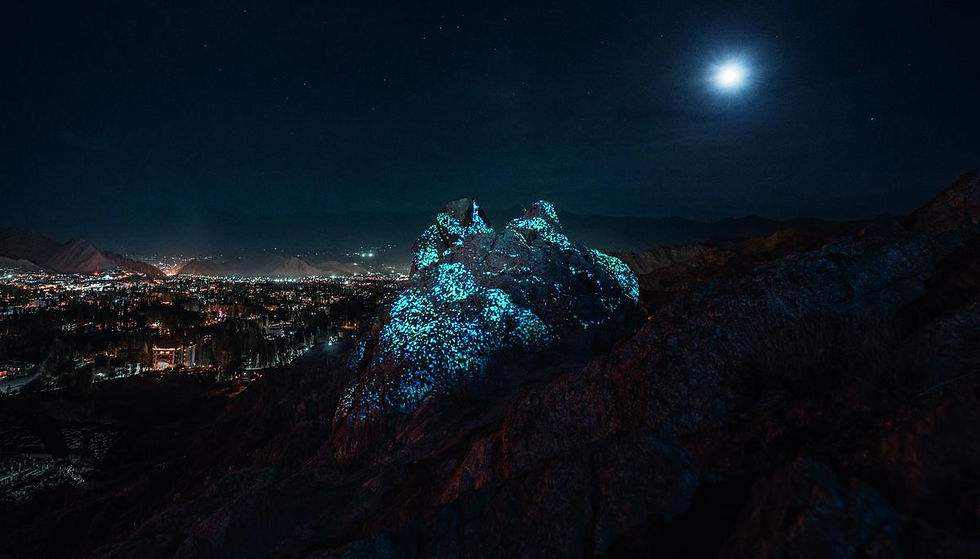
A village, an old structure, a mountain route or a local material can influence how an artwork is conceived, experienced and understood.
Why "regenerative"?
The word regenerative is central to sā.
The biennale's approach goes beyond the familiar idea of making an art event "sustainable".
Its organisers describe regeneration as a methodology that considers materials, production, community participation, education and the longer-term impact of the project. The intention is to ask whether cultural activity can contribute something back to the places and communities in which it takes place.
That question becomes particularly relevant in Ladakh.
The region is ecologically fragile and is already dealing with changing weather patterns, water concerns, pressure from tourism and transformations in its landscape. Holding a large cultural event here therefore creates an obvious contradiction: how do you bring more people into a sensitive environment while asking them to think about protecting it?
sā does not pretend that this contradiction disappears. Instead, it makes that tension part of the conversation.
Where does the biennale take place?
The exhibition stretches across the Leh-Kargil route, with sites including Leh, Basgo, Likir, Nurla, Lamayuru, Henasku, Mulbekh and areas around Kargil. The official visitor information describes the biennale as a journey that can be approached from either Leh or Kargil, allowing visitors to move through the sites at their own pace.
This changes how you experience an exhibition.
You do not simply enter a gallery, see twenty works and leave. You travel between them.
The road, the weather, the villages and the landscape become part of the encounter. In that sense, the biennale asks visitors to slow down and pay attention not only to artworks, but also to the places in which those artworks exist.
Why should the sā Ladakh Biennale matter?
There are plenty of biennales around the world. What makes this one interesting is not simply that it happens at an extraordinary altitude.
It is the question behind it.
Can contemporary art engage with a place without treating that place as a backdrop?
Can an international art event work with local knowledge rather than simply bringing an outside cultural model into a region?
And can an exhibition leave behind relationships, knowledge and conversations rather than only photographs and temporary installations?
The sā Ladakh Biennale is an attempt to explore these questions.
Perhaps its most interesting contribution to the Indian art landscape is therefore not its claim to be the world's highest biennale.
It is the possibility of making place part of the curatorial process itself.
In Ladakh, the exhibition does not end where the artwork ends. The journey is part of the work.

