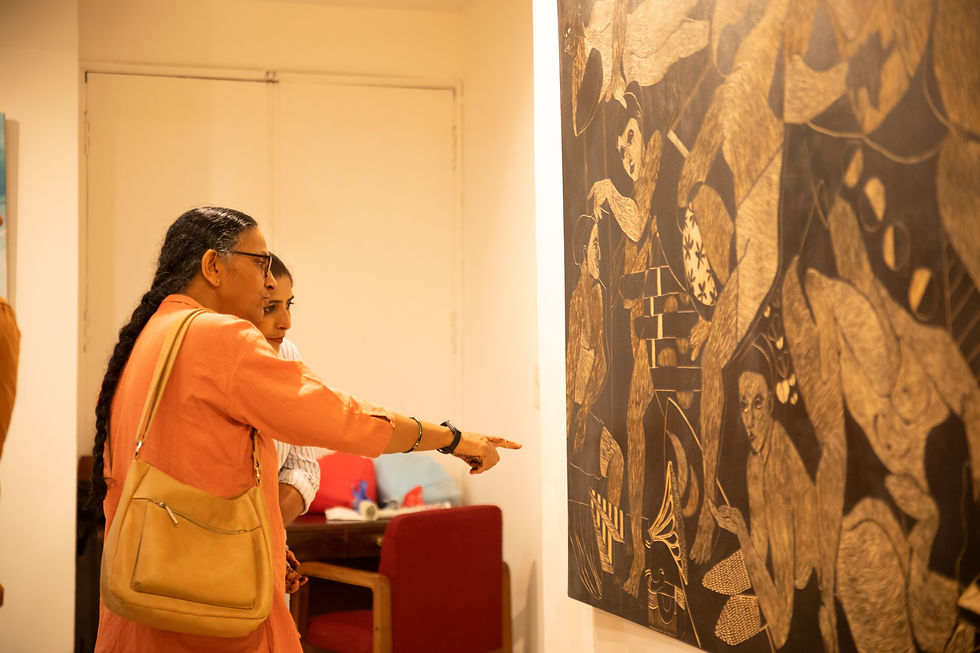
Beyond Decoration: How Art Supports Employee Wellbeing and Creates Healthier Workspaces

Walk into most offices today and you'll notice something has changed.
The sterile rows of desks, blank walls, and purely functional interiors that once defined the workplace are gradually disappearing. In their place are spaces designed to feel more human: natural light, biophilic elements, collaborative zones, and increasingly, thoughtfully curated art.
This shift is not simply aesthetic.
It reflects a growing understanding that the environments we spend time in shape how we think, feel, collaborate, and perform. As organisations continue to invest in employee wellbeing, the conversation is expanding beyond wellness programs and flexible working policies. Increasingly, attention is turning toward the physical environment itself.
And within that conversation, art is emerging as a surprisingly powerful tool.
At Artlune, we often encounter a common misconception: that artwork in offices serves primarily as decoration. Something chosen to fill empty walls or make a reception area appear more sophisticated.
But research suggests art can do far more than improve appearances. When integrated thoughtfully into workplaces, hospitality environments, residential developments, and public spaces, art can positively influence mood, reduce stress, encourage creativity, strengthen cultural identity, and contribute to overall well-being.
The question is no longer whether art belongs in professional environments. The question is how thoughtfully it is being used.

Why Workplace Wellbeing Has Become a Business Priority
The conversation around employee well-being has evolved dramatically over the past decade.
Burnout, stress, workplace fatigue, and mental health challenges are no longer viewed as individual issues alone. They are increasingly recognised as organisational concerns that directly impact productivity, retention, engagement, and innovation.
According to the World Health Organisation, burnout has become one of the most significant occupational challenges globally. Meanwhile, Gallup's workplace studies consistently show strong links between employee well-being and business performance, including higher productivity, stronger retention rates, and improved collaboration.
As organisations seek solutions, many focus on policies and programs. These are important. But they often overlook a critical factor: The environment itself.
People spend a significant portion of their lives inside workplaces. The spaces surrounding them become part of their daily psychological experience.
A poorly designed environment can contribute to stress, distraction, and disengagement.
A thoughtfully designed environment can support focus, calm, creativity, and connection.
This is where art enters the conversation.
Art Influences More Than What We See
When discussing workplace design, functionality often dominates decision-making.
Questions revolve around efficiency, workflow, occupancy, and space utilisation.
Yet human beings do not experience spaces purely through function. We respond emotionally.
Colours influence mood. Light affects energy levels. Materials create sensory experiences. Art contributes another important layer by introducing meaning, narrative, and emotional engagement.
Research published through the Creative Health initiative in the UK found strong links between cultural engagement and improved mental well-being. Studies consistently demonstrate that interaction with visual art can reduce stress, stimulate curiosity, encourage reflection, and improve emotional resilience.
This matters because stress is rarely caused solely by workload.
It is often amplified by environments that feel impersonal, monotonous, or psychologically draining. Art interrupts that experience.
A thoughtfully placed artwork can create a moment of pause during a demanding day. It can spark conversation between colleagues. It can encourage reflection, inspiration, or simply provide visual relief from repetitive surroundings.
These seemingly small moments accumulate over time.
Creativity Thrives in Stimulating Environments
One of the most interesting findings emerging from workplace research is the relationship between environment and creative thinking.
Innovation rarely happens in spaces that feel emotionally flat.
Studies from psychology and workplace design researchers have shown that visual stimulation can encourage divergent thinking, problem-solving, and idea generation. Exposure to art encourages people to interpret, question, imagine, and engage with multiple perspectives—many of the same cognitive processes involved in innovation.
For organisations operating in creative industries, technology, consulting, education, or design, this becomes particularly relevant.
Employees are increasingly valued not only for execution but also for original thinking.
Art can support this by creating environments that stimulate curiosity rather than simply accommodating tasks.
This does not mean every office should resemble a gallery.
Rather, it highlights the importance of incorporating visual experiences that enrich the intellectual and emotional atmosphere of a space.
Art Creates Emotional Connection Within Workplaces
One of the less discussed benefits of workplace art is its ability to humanise environments.
Many offices are designed for efficiency. Few are designed for emotional connection.
Art helps bridge that gap.
When employees feel emotionally connected to their environment, they are more likely to feel a sense of belonging within it. This is particularly important as organisations continue navigating hybrid work models where employees increasingly compare workplace experiences with the comfort of home.
Thoughtfully curated art can communicate values, identity, and culture.
It can reflect local communities, celebrate diversity, encourage inclusion, or simply create a more welcoming atmosphere.
For clients, visitors, and employees alike, artwork often becomes one of the first emotional touchpoints within a space.
Unlike branding statements or mission documents, art communicates visually and intuitively.
It tells people what kind of environment they have entered before a single conversation takes place.
Why Interior Designers and Architects Are Paying Attention
For interior designers and architects, the conversation around art is becoming increasingly strategic.
Historically, artwork was often introduced toward the end of a project as a finishing touch.
Today, many leading firms are integrating art much earlier within the design process.
Why?
Because art has the ability to shape how spaces are experienced.
A carefully curated collection can establish visual identity, guide movement through a space, create focal points, soften architectural rigidity, or reinforce broader design narratives.
In workplace environments, art can support specific objectives such as:
Creating calm zones within high-pressure environments
Encouraging collaboration in communal spaces
Enhancing employee engagement
Strengthening workplace identity
Supporting wellness-focused design strategies
Improving visitor and client experiences
Increasingly, art is being considered not as decoration but as part of the overall user experience. And that distinction matters.
Property Developers Are Beginning to View Art as an Asset
The relationship between art and property development has also evolved significantly.
Developers are recognising that people increasingly seek experiences rather than simply square footage.
Whether residential, commercial, hospitality, or mixed-use developments, occupants are drawn toward environments that feel distinctive, memorable, and meaningful.
Art contributes to that differentiation.
A thoughtfully curated art strategy can strengthen placemaking efforts, create community identity, and increase perceived value within developments.
Research across real estate and hospitality sectors has shown that environments incorporating cultural and artistic experiences often generate stronger emotional engagement from occupants and visitors.
For developers, this presents an opportunity to move beyond purely functional spaces and create destinations that people genuinely want to spend time in.
Art at Home: The Wellness Conversation Extends Beyond Offices
While workplace wellbeing remains a major focus, many of the same principles apply within residential environments.
The rise of remote and hybrid working means people now spend more time than ever inside their homes. As a result, conversations around wellness-driven interiors are extending into residential design.
Art plays an important role here, too. People often choose artworks that reflect personal memories, aspirations, values, or emotional experiences.
These pieces become more than visual objects. They contribute to comfort, identity, and emotional grounding.
Research in environmental psychology suggests that personalised environments positively influence mood, emotional well-being, and perceived quality of life.
Art allows individuals to create spaces that feel emotionally meaningful rather than merely functional.
The Future of Workplace Design Is Human-Centred
Perhaps the most important shift happening today is a broader movement toward human-centred design.
Organisations increasingly recognise that people perform best in environments that support both productivity and wellbeing.
Art contributes to this balance in unique ways.
It encourages reflection in environments often dominated by speed.
It introduces humanity into spaces designed around efficiency.
It creates opportunities for connection in places where isolation can easily emerge.
And perhaps most importantly, it reminds us that workplaces are not simply systems or buildings. They are environments experienced by people.
Final Thoughts
Art will not solve workplace stress on its own. Nor will it replace good leadership, healthy culture, or meaningful wellbeing policies.
But it can play a valuable supporting role.
For interior designers, architects, workplace strategists, and property developers, art offers an opportunity to think beyond aesthetics and consider how environments influence emotional and psychological well-being.
At Artlune, we believe art's greatest value lies not only in what it adds to a space visually, but in how it shapes the experience of the people who inhabit it.
Because ultimately, great spaces are not remembered for how they looked. They are remembered for how they made people feel.
References
World Health Organisation (WHO) – Workplace Mental Health and Burnout Research
Creative Health Report (UK) – Arts, Health and Wellbeing Findings
Gallup Workplace Studies – Employee Wellbeing and Performance Research
Harvard Business Review – Workplace Design and Employee Engagement
Environmental Psychology Research on Art and Wellbeing
Arts Council England – Creative Health and Cultural Participation Studies
International WELL Building Institute – Workplace Wellness Standards
Journal of Environmental Psychology – Impact of Visual Environments on Human Behaviour
Deloitte Human Capital Trends Report – Employee Experience and Workplace Design
McKinsey & Company – Future of Work and Employee Wellbeing Studies